

Every conversation I have with marketing and growth leaders comes back to the same problem. It is not that they lack tools or dashboards. It is that they still feel they are making big decisions with partial information. In our recent AdClarity webinar, I summarized this as three market challenges: data, efficiency, and money. All three show up every day in how teams plan, optimize, and report on campaigns.
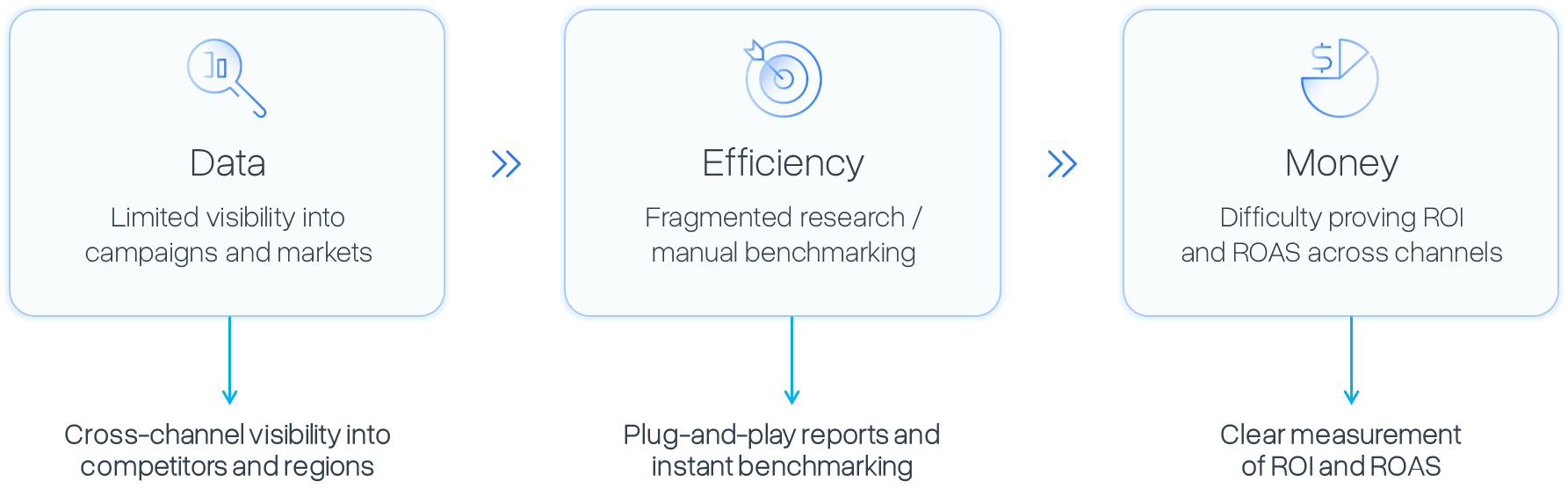
Data: Seeing The Whole Market, Not Just Your Slice
The first question is simple. What visibility do you actually have into campaigns and markets? Many teams see a narrow view: their own media plans, a few platforms, or one region at a time. That makes it very hard to answer basic competitive questions. Who is really investing in my category? Which channels carry the weight? Where am I under or over exposed?
Access alone is not enough. The next question is quality. Even if you have data, can you trust the way it is collected, modeled, and refreshed. Does each channel follow the same logic so you can compare spend to spend and channel to channel.
Choose an ad intelligence platform that is built to remove that uncertainty by providing cross-channel visibility into competitors and regions in a single platform, using one methodology for all the major advertising channels. Instead of juggling separate tools for TV, CTV, video, display, and social advertising, work with one source of truth.
Efficiency: From Manual Benchmarking to Instant Answers
The second challenge is efficiency. Without strong competitive data, teams spend countless hours trying to recreate it. They scrape sites, pull exports from multiple platforms, build one off spreadsheets, and run manual benchmarks. Yes, AI can help, but if the inputs are fragmented the work still takes too long and is hard to repeat.
What we see every day is that this effort quickly becomes a hidden tax on the team. Time that should go into strategy is instead spent cleaning data and chasing basic answers.
Choose a platform that is designed to give you plug-and-play reports and instant benchmarking. Instead of building a new deck every time someone asks how a competitor behaves in a market, you should open one view and see their spend, channels, creatives, and trends side by side with your own.
Money: Proving ROI with Fewer Blind Spots
The third challenge is money. Ultimately, every agency or brand marketing leader has to prove ROI and ROAS across channels. That is almost impossible if your view of the market is incomplete. You might be reporting solid results while competitors quietly outspend you on a channel you barely track. Or you might be underestimating ROI because you miss part of the journey where your brand shows up.
Clear, channel-neutral measurement changes that. When you have a holistic picture of how your category invests and how your own mix compares, ROI discussions become grounded. You can show where you lead, where you lag, and which shifts are likely to drive the biggest impact.
The Goal: Less Noise, More Clarity
The point of competitive intelligence is not to bombard teams with more data. It is to remove blind spots so they can act with confidence in an ecosystem that is fragmented and highly competitive. At BIScience, we see how a clearer external view changes the way our partners make decisions: they move faster, invest with more conviction, and catch shifts earlier.
If your team is still stitching together partial signals to answer basic competitive questions, it might be time to rethink the foundation. With a single ad intelligence platform across all major channels, fewer blind spots can translate directly into better campaigns and higher ROI.
By Daniel Junowicz, VP of Sales at BIScience