The arrival of advertising in a new market does not mean advertisers immediately embrace it. Some countries attract investment quickly, while others take longer to develop. ChatGPT Ads offer an early example of how uneven that adoption can be, even as the channel becomes available to more brands around the world.
As ChatGPT advertising expands internationally, marketers face a new question: not simply whether competitors are present, but how quickly spending, category activity, and the wider media mix are changing in each market.
Global Availability Is Not the Same as Market Maturity
Following OpenAI’s October expansion, ChatGPT Ads became available in 89 markets, with more than 100,000 advertisers having run campaigns. Yet availability alone says little about how budgets are being allocated across those markets.
AdClarity’s October 2026 dataset measured an estimated $110.6 million in ChatGPT ad spend across 24 monitored countries. Nearly 64% came from the US, where estimated monthly spend reached $70.7 million, up 127% from $31.1 million in April. The concentration makes clear that a growing global footprint can coexist with very different levels of advertiser adoption.

Different Countries, Different Growth Curves
Among markets monitored since June, estimated spending in the UK rose 195%, from $2.1 million to $6.2 million by October. Japan grew 103%, from $2.9 million to $5.9 million. In October, Australia recorded $4.1 million, Canada $3.3 million, and Germany $2.6 million.
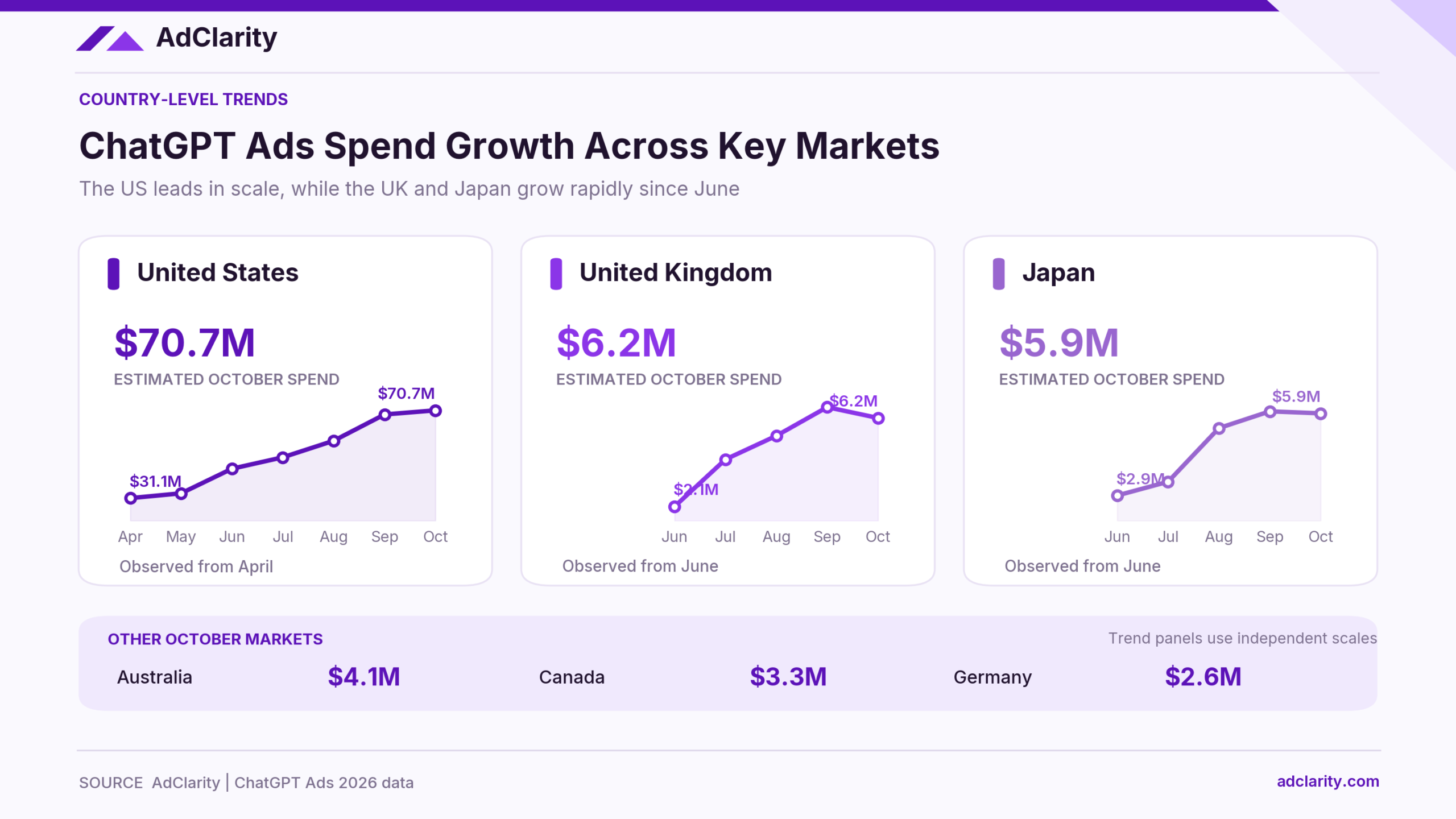
These figures do not establish which market will lead next. They do show why a global average can hide shifts that matter for regional planning. An advertiser may be entering an emerging channel aggressively in one country while still testing it in another.
Category Activity Reveals the Early Use Cases
Country differences are only part of the picture. In October, Programming and Developer Software accounted for an estimated $27.9 million, about a quarter of the tracked ChatGPT Ads market. Graphics, Multimedia and Web Design followed at $7.2 million, with activity also visible in Jobs and Employment ($4.6 million), Education ($3.9 million), and Travel and Tourism ($2.3 million).
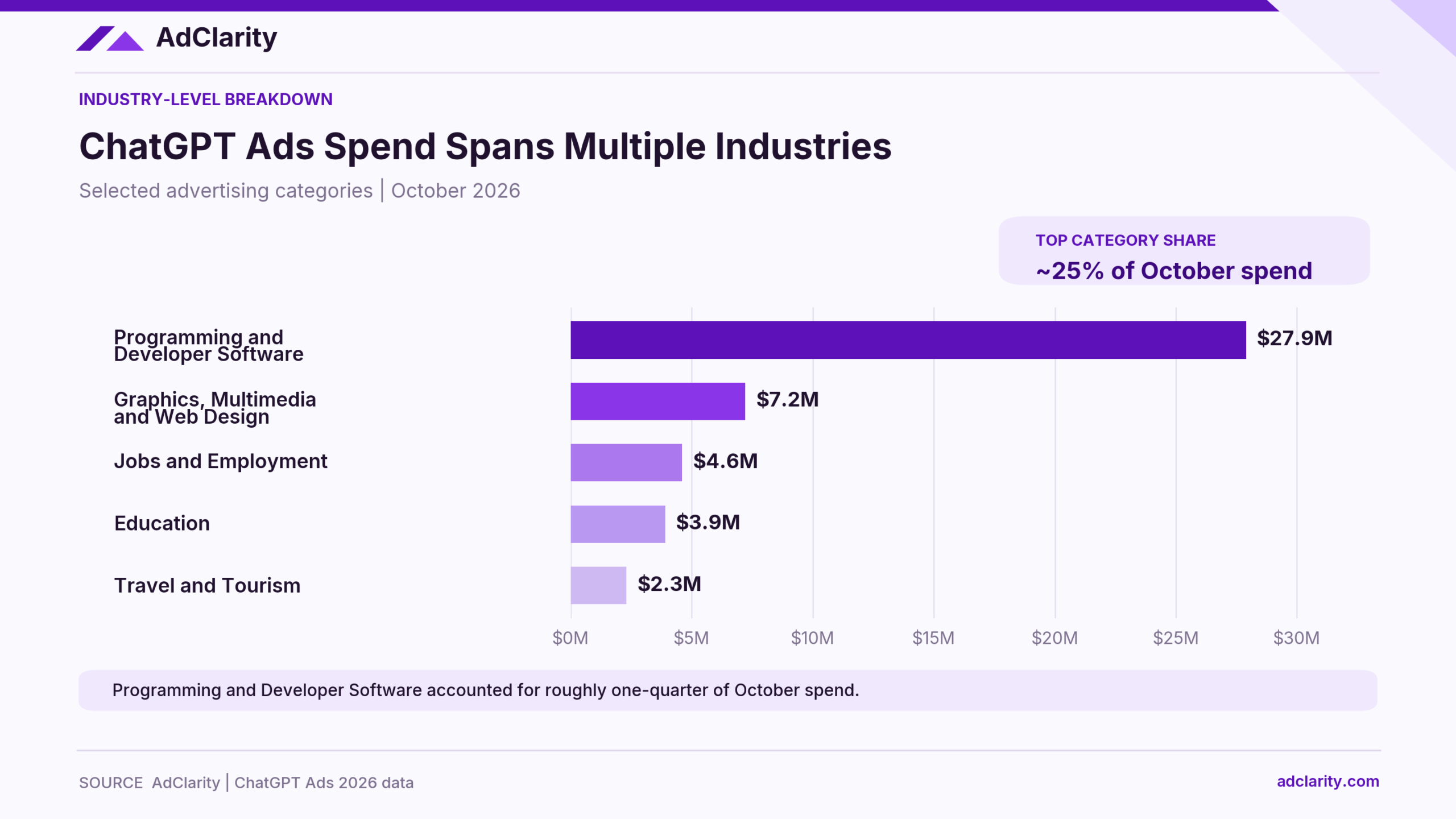
For marketers, this mix suggests a useful line of inquiry: which categories are investing already, which competitors are testing the channel, and what do their messages and landing pages indicate about campaign objectives? Tracking those changes over time can be more informative than treating a single campaign as proof of a broader market trend.
The Bigger Question Is Where Budgets Move Next
Emerging channels do not develop in isolation. As advertisers add ChatGPT Ads to their plans, they may adjust investment in display, social, online video, CTV, linear TV, or other media. Understanding whether a brand is adding new budget or reallocating existing spend requires looking beyond the new channel itself.
As of this month, AdClarity supports ChatGPT Ads intelligence across 51 markets using a consistent methodology, enabling country-level comparisons alongside established digital and TV channels. That shared view helps teams monitor competitors, assess regional differences, and form better questions about potential budget shifts.
The opportunity for marketers is to follow adoption as it unfolds, not assume that a channel’s global launch produces one global trend. In ChatGPT advertising, the most useful insight may be where the market is moving differently.