
Competitive intelligence can support two very different agency conversations. In a new-business pitch, the goal is to give the prospect a reason to rethink the current approach. With an existing client, the goal is to connect a competitive gap or missed opportunity to a credible growth decision.
The same underlying evidence can support both outcomes, but the recommendation needs to fit the conversation. The central idea is simple: competitive data becomes valuable when it is translated into a business story, an agency point of view, and a measurable next step.
The Same Evidence Needs Two Different Narratives
When the objective is to win an account, the story should begin with the prospect’s concern in its own language. Competitive evidence can then show what existing campaign reporting may not reveal, frame a potential blind spot, and explain what the agency would do differently. The first ask may be a transition plan, a defined market test, or the next stage of the pitch.
Growing an existing account requires a different tone. The agency is not trying to criticize the current plan. It is trying to show where category conditions, competitor behavior, or the client’s growth priorities may justify a different allocation, an incremental investment, or a focused test. The ask should be connected to a defined business outcome rather than to competitor spend alone.
Build the Growth Case Around a Measurable Gap
Several competitive signals can open a budget discussion. A priority DMA may trail the national position. Reach may lag competitors at a similar investment level. Premium video may be expensive relative to reach. Competitors may begin shaping demand before the client’s activity starts.
None of those signals automatically means “spend more.” A stronger agency recommendation defines the move and the proof. Reallocate budget toward a priority market and measure reach or local position. Add budget to an earlier competitive window and measure incremental reach or response. Add a creative, audience, publisher, or local-market test with a clear learning agenda. Scale only after the test meets agreed criteria.
Use Cross-Media and Local Context to Find What Averages Hide
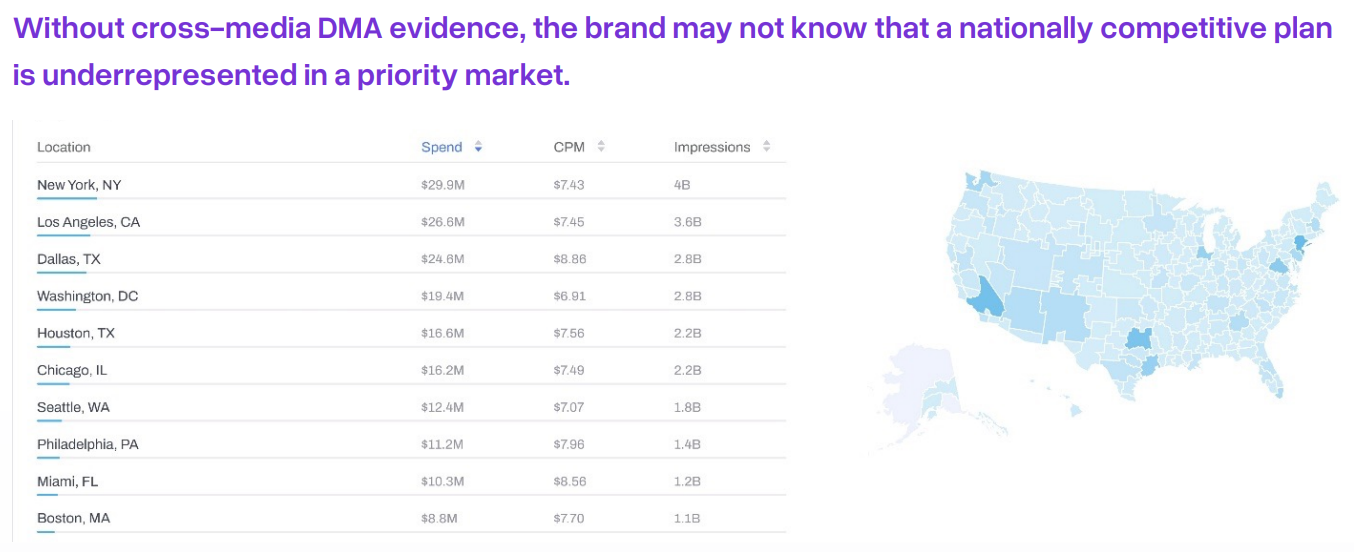
National or total-market averages can hide the issue that really matters. Cross-media DMA analysis can reveal whether a brand that looks competitive nationally is underrepresented in a priority local market. Channel analysis can show whether total investment is masking an underfunded role such as reach, discovery, premium attention, or response.
Product and activation context can sharpen the story further. Taxonomy can narrow the competitive set by topics and tags before the agency compares publishers, audiences, objectives, creative activity, or CTR. Again, the principle is not to show every available layer. It is to include only the evidence that changes the decision.
Make the Ask Easy to Repeat
A strong agency story should survive after the deck is closed. The client should be able to repeat the competitive problem, the agency difference, and the first measured action. That is why it helps to end with one growth ask and one proof plan, not a larger collection of charts.
Download The Agency Growth Pitch Playbook for free to get the full framework, new-business and client-growth examples, measurable budget logic, competitive evidence snapshot, planning checklist, and right-sized deck workflow.


